

TL;DR: ChatGPT ads in Australia are delivering an average CPC of A$6.39, a blended CPM of A$86.81 and a 1.36% CTR in our first week of live campaign data. JBE Digital is running the campaign for our own PPC services on a modest test budget: 1,472 impressions and 20 clicks so far. The platform has opened up considerably since March, conversion tracking now exists, and the first 30 days are best treated as a diagnostic.
The platform has changed since March
When we covered the ChatGPT ads launch in March, the picture was clear. Reported CPMs around $60 USD, minimum commitments near $200,000 USD, impression-based buying and no conversion tracking. Our advice at the time was blunt: most Australian businesses should focus on organic AI visibility and leave the paid placements to enterprise brands.
That advice had a shelf life, and it expired faster than we expected.
We now have a live campaign running for our own PPC services. The account supports click-based campaigns, the dashboard includes a conversions column, and our actual spend for the first week was A$127.79. The enterprise-only era lasted a matter of months.
This is how new ad platforms tend to evolve. The early access phase generates headlines about huge minimums, then broader access quietly changes the economics. Anyone still making decisions based on March coverage, including ours, is working from outdated information.
How we set the campaign up
We are running one campaign promoting our PPC management services, structured around six context hints mapped to different buyer intent groups. Context hints are how ChatGPT decides when your ad is relevant. You describe the conversations your business belongs in, and the system matches your ad when a free tier user has a relevant conversation. There is no keyword or prompt based bidding (yet).
This is the single biggest mental shift coming from Google Ads. There is no search term report in the traditional sense. You are describing intent territory, and your context hints become the closest thing the platform has to match types. The breadth of each hint shapes both delivery volume and conversation quality, and getting that balance right is most of the setup work.
We launched two ad variations against those hints, each with different creative and messaging, because week one on any new platform is about learning which framing the auction and the audience respond to.
The first week numbers
Here is the ChatGPT Ad campaign data:
| Metric | Result |
|---|---|
| Impressions | 1,472 |
| Clicks | 20 |
| CTR | 1.36% |
| Average CPC | A$6.39 |
| Average CPM (blended) | A$86.81 |
| Spend | A$127.79 |
The two ads performed very differently, which is the most useful finding of the week.
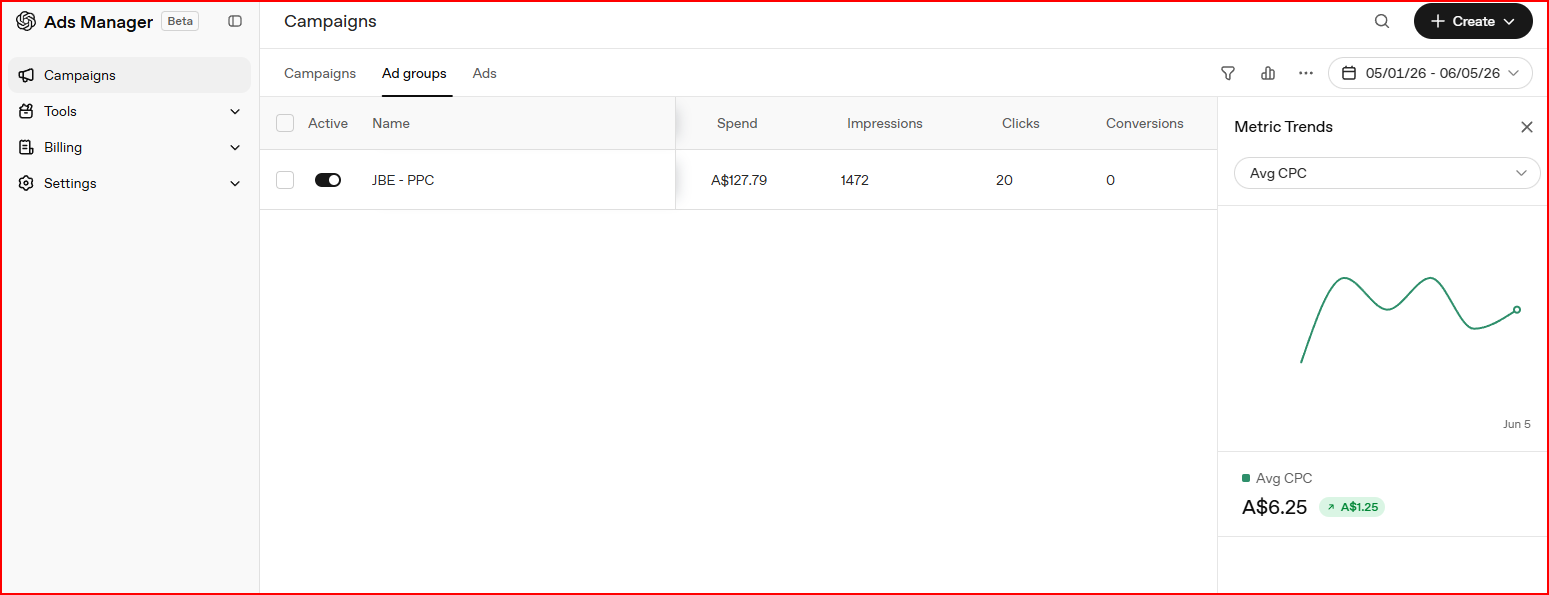
Our first ad, focused on Google Ads management for businesses spending $2K+ per month, recorded a 2.65% CTR at a A$6.25 CPC. Our second ad, a broader PPC management message leading with our team’s combined experience, delivered the bulk of impressions (1,321) at a 1.21% CTR and a A$6.42 CPC.
The qualification-led ad earned more than double the click-through rate of the experience-led ad. One week of data on small volumes proves nothing on its own, and we are treating this as a hypothesis to test. The early signal is that naming exactly who the ad is for earns the click. The person reading it is mid-conversation about their problem, and the ad that names their situation wins.
What the costs tell us
A blended CPM of A$86.81 sits close to the early reported figures of around $60 USD, so the placement is priced as premium inventory even now. For comparison, Meta CPMs in Australia typically run A$10 to A$25.
The CPC is the more interesting number. At A$6.39, we are paying less per click than many competitive Google Ads service categories in Australia, where agency and B2B service terms regularly clear $15 or more per click. If the traffic quality holds up, that gap is meaningful.
That “if” is doing a lot of work, which brings us to tracking.
Conversion tracking exists now
This is the most significant change since launch. The platform now supports conversion tracking, and we configured ours to measure what actually matters for a service business: phone calls and form submissions, the same conversion events we track on every client account. It is the same principle we covered in our piece on measuring what matters in paid media.
A week of clicks on a small test budget is far too early to judge conversion performance, and we are not pretending otherwise. ChatGPT traffic also arrives earlier in the research process than a high-intent Google search. A person clicking mid-conversation about marketing strategy is still forming the problem. The Google searcher typing “PPC agency Melbourne” already has their credit card half out.
The honest read: the plumbing works, the tracking is live, and the next three weeks tell us whether the channel converts.
What we are watching over the next 30 days
We framed this campaign internally as a diagnostic, and these are the questions it needs to answer.
Whether the CTR gap between specific and broad messaging holds as impressions scale. Whether clicks turn into calls and forms at a rate that justifies a A$6+ CPC. How context hints behave over time: which ones drive delivery, which ones drive quality, and how much control we really have over the conversations we appear in. And whether the platform’s reporting matures enough to optimise with confidence.
We will publish the full 30-day results when the diagnostic period closes. Early adopters on every major ad platform bought cheap learning that later arrivals paid full price for. We expect the same pattern here.
Want to be on the platform early?
We are one of the few Australian agencies running live spend on ChatGPT ads, testing with our own money before we recommend the channel to clients. If you want your business in front of ChatGPT users while competition is thin, we can get you set up, tracked and managed properly.
Frequently asked questions
Can anyone run ChatGPT ads in Australia now?
Access has opened up significantly since the March launch, and the enterprise-only minimums reported at launch no longer reflect what we are seeing inside the platform. We are running a live campaign at a modest test budget. If you want to know whether your business can get on the platform, get in touch and we can walk you through it.
How much do ChatGPT ads cost per click?
Our first week averaged A$6.39 per click with a blended CPM of A$86.81. That CPM prices the placement as premium inventory, well above typical Meta rates in Australia. The CPC compares favourably with competitive Google Ads service categories, where clicks regularly cost $15 or more. These are early figures from a small sample and will shift as the platform matures.
How are ChatGPT ads targeted?
Targeting works through context hints rather than keywords. You describe the conversations your business belongs in, and ChatGPT matches your ad when a free tier user has a relevant conversation. There is no behavioural profiling and no keyword bidding. Writing context hints at the right level of breadth is the core skill of campaign setup.
Can you track conversions from ChatGPT ads?
Yes. This is one of the biggest changes since launch. The platform now supports conversion tracking, and we have ours configured to measure phone calls and form submissions. Tracking is still maturing compared with Google Ads or Meta, and we expect reporting depth to improve as the platform develops.
What CTR should I expect on ChatGPT ads?
Our first week ran at 1.36% overall, with our best ad reaching 2.65%. The clearest early signal was that specific, qualification-led messaging earned more than double the click-through rate of broader credential-led messaging. Treat any benchmark from this early in the platform’s life as indicative only.
Should my business advertise on ChatGPT now?
It depends on your appetite for testing. The platform is early, volumes are small, and conversion data is thin. The case for moving now is the learning advantage: advertisers who understand context hints, creative angles and tracking before the platform gets competitive will be ahead of those who wait. We recommend treating the first 30 days as a diagnostic with a budget you can afford to spend on learning.
