

TL;DR: AI has reduced the cost of content but increased buyer hesitation. Growth is no longer constrained by traffic alone. It is constrained by trust. Businesses that build credibility across Formation, Distribution, Evaluation and Capture into a unified loop outperform those that optimise marketing activity in isolation.
Why Growth Feels Harder Than It Should
Artificial intelligence has fundamentally changed the economics of marketing. Websites can be built in days. Campaign copy can be generated in minutes. Social content can be scaled without friction. On the surface, competition appears to have intensified.
The deeper change is not competition. It is credibility.
When every business looks competent, buyers become more cautious. Professional design, polished messaging and consistent content are now baseline expectations. They no longer differentiate. As a result, decision-making slows.
Established businesses often interpret this as a lead generation problem. In reality, it is a hesitation problem.
Traffic increases exposure. It does not automatically increase conviction.
The Real Constraint: Buyer Hesitation
Most multi-million dollar businesses are not short on marketing activity. They invest in paid media, search visibility and social distribution. They generate enquiries. They run campaigns.
Yet growth becomes volatile.
Cost per acquisition increases. Lead quality fluctuates. Sales cycles extend. Forecasting becomes less predictable.
This volatility rarely stems from a lack of traffic. It stems from a lack of structured trust.
When conviction is weak, more traffic amplifies inefficiency. When conviction is strong, steady traffic compounds into predictable revenue.
Growth is no longer constrained by distribution alone. It is constrained by how confidently buyers move through your ecosystem.
Trust as Infrastructure, Not Branding
Trust is often framed as authenticity, tone of voice or brand personality. These elements matter, but they are not the structural layer.
Trust operates as infrastructure.
It determines whether serious buyers discover you during research, perceive you as credible, believe your commercial claims, move confidently through your conversion process and understand the financial value you create.
When trust is embedded structurally, performance stabilises. When it is superficial, performance fluctuates.
This distinction explains why many growth strategies plateau. They optimise channels rather than conviction.
Introducing The Trust Layer
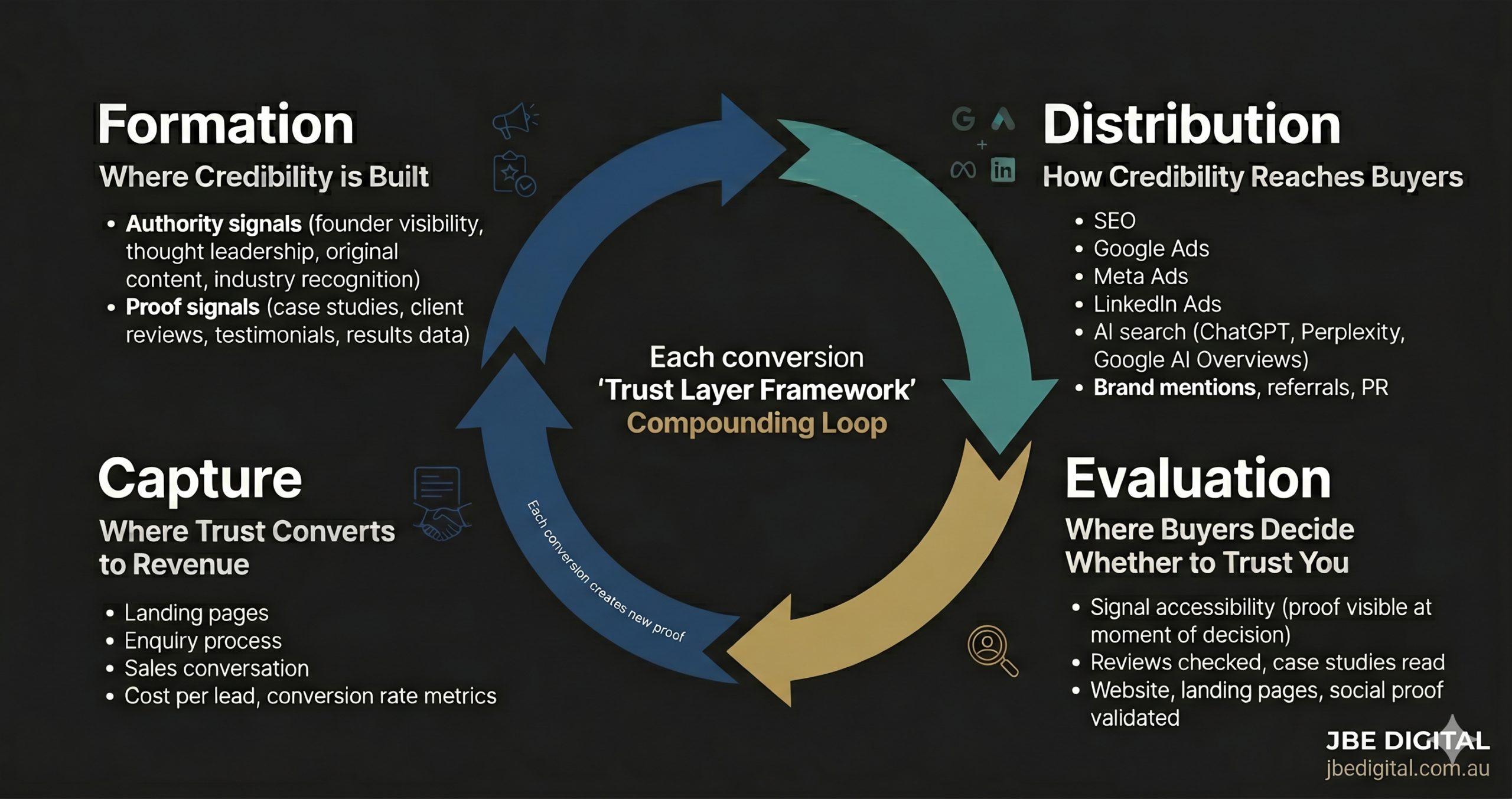
The Trust Layer is a unified system designed to reduce hesitation across the entire buyer journey. It is not a linear checklist. It operates as a compounding loop and each stage feeding the next, strengthening the whole system over time.
It integrates four structural stages.
Formation
Formation is where credibility is built. It includes the authority signals that demonstrate expertise: founder visibility, original thinking, industry recognition. And the proof signals that validate claims: case studies, reviews, client outcomes and measurable results. Formation is the foundation. Every other stage depends on it.
Distribution
Distribution is how credibility signals reach serious buyers. This includes traditional search engine optimisation as well as visibility within generative platforms.
Understanding the difference between traditional optimisation and generative visibility is critical. Our breakdown of SEO vs GEO: Generative Engine Optimisation Explained for Visibility explores how search behaviour has evolved.
Advanced distribution strategies now extend into AI-driven systems. Our work in AI SEO explains how large language models evaluate credibility and surface authoritative sources.
Distribution does not create trust. It creates the opportunity for trust to be tested.
Evaluation
Evaluation is the moment a buyer encounters your business and decides whether to believe it. This is the most overlooked stage in most marketing frameworks — and the one where the most revenue is lost.
Buyers do not convert because you appear credible. They convert when hesitation has been systematically reduced at the point of decision. Reviews, case studies, social proof and brand consistency must be visible and accessible at the exact moment buyers are looking. A proof signal that exists but cannot be found is functionally absent.
Capture
Capture is where trust converts into revenue. Conversion infrastructure ensures your website, landing pages and enquiry processes reinforce confidence rather than introduce friction. Design, messaging hierarchy and call-to-action structure must align with the authority already established.
Capture also includes revenue clarity: connecting marketing activity directly to financial outcomes. Without visibility into cost per acquisition, lifetime value and conversion velocity, internal trust erodes alongside external trust.
When these four stages operate independently, growth becomes inconsistent. When they operate as a unified loop, performance stabilises and compounds.
Measuring Your Position: The Trust Index
Knowing the framework exists is not enough. Businesses need to know where they stand within it.
The Trust Index is the measurement system for The Trust Layer. It evaluates a business across all four stages: Formation, Distribution, Evaluation and Capture — and produces a composite score between 0 and 100. More importantly, it identifies precisely where the loop is breaking and what to address first.
Most businesses score well in one or two stages and have significant gaps in others. A business with strong distribution but weak formation is spending money amplifying insufficient credibility. A business with strong formation but weak evaluation is losing buyers at the moment of decision despite having all the right signals.
The Trust Index makes those gaps visible and actionable.
Why Traditional Marketing Models Plateau
Many agencies optimise activity metrics. Impressions. Click-through rates. Cost per lead.
These metrics matter, but they do not address hesitation.
Paid media platforms can drive targeted traffic efficiently when structured correctly. Our approach to PPC management reflects this.
Search engine optimisation remains critical for long-term visibility and sustainable demand capture. Our broader Search Engine Optimisation services outline how this compounds over time.
Yet visibility without structured trust leads to volatility.
The businesses that outperform do not abandon channels. They integrate them into a cohesive system built around conviction.
Lead Generation in the AI Era
Traditional lead generation frameworks focus on increasing enquiry volume. In practice, decision velocity and lead quality determine commercial performance.
Our guide on Understanding Lead Generation explores acquisition mechanics in depth.
What has changed is not the mechanics alone, but the trust threshold required for conversion.
Buyers no longer convert because you appear credible. They convert when hesitation has been systematically reduced.
That reduction is engineered, not improvised.
Global Visibility and Generative Search
Generative engines now influence how businesses are surfaced across digital ecosystems. Large language models evaluate brand signals, structured data, authority depth and consistency across channels.
Optimising for both traditional search engines and generative platforms is now essential. GEO strategies complement SEO strategies, expanding discoverability into AI-generated responses.
However, even perfect visibility does not guarantee performance. If formation signals are weak, traffic increases comparison rather than conversion.
Trust must operate across every stage of the loop.
Frequently Asked Questions
What is The Trust Layer in digital marketing?
The Trust Layer is a structured growth system integrating Formation, Distribution, Evaluation and Capture into a compounding loop that reduces buyer hesitation and increases predictable revenue.
What is The Trust Index?
The Trust Index is the measurement system for The Trust Layer. It scores a business across all four stages and identifies where credibility gaps are suppressing growth.
How does AI affect trust in marketing?
AI has made content production easier and more widespread. This increases competitive noise and raises the importance of clear authority signals and measurable proof. AI systems also now select sources based on credibility signals, making trust infrastructure essential for visibility, not just conversion.
Is traffic still important?
Yes. Traffic remains essential. However, without structured trust, traffic does not convert efficiently and often increases volatility.
What is the difference between SEO and GEO?
SEO focuses on ranking within traditional search engines. GEO focuses on visibility within generative search environments powered by large language models. Both influence discoverability and authority in the AI era.
The Strategic Implication
In the AI era, producing marketing is easier than ever. Earning conviction is harder than ever.
Businesses that treat trust as infrastructure rather than branding will define the next phase of growth. Those that continue optimising activity without restructuring conviction will experience increasing volatility.
The market is not short on content. It is short on structured trust.
