TL;DR: You can now claim your business in ChatGPT. OpenAI launched Businesses in ChatGPT in beta on 10 November 2026, with a new Business Hub where a verified business can manage its details, see how often ChatGPT mentions it and count the clicks ChatGPT sends to its website.
Australian businesses can start the claim today, with online stores and online service businesses first in line. We tested it with JBE Digital on launch day. ChatGPT found our listing and the claim went onto a waitlist. Local shopfronts and restaurants can’t claim yet, and Business Agents are limited to eligible US businesses at launch.
Claiming gives ChatGPT accurate information about your business. OpenAI states that it carries no guarantee of higher placement, so the credibility signals across the wider web still decide which businesses get recommended.
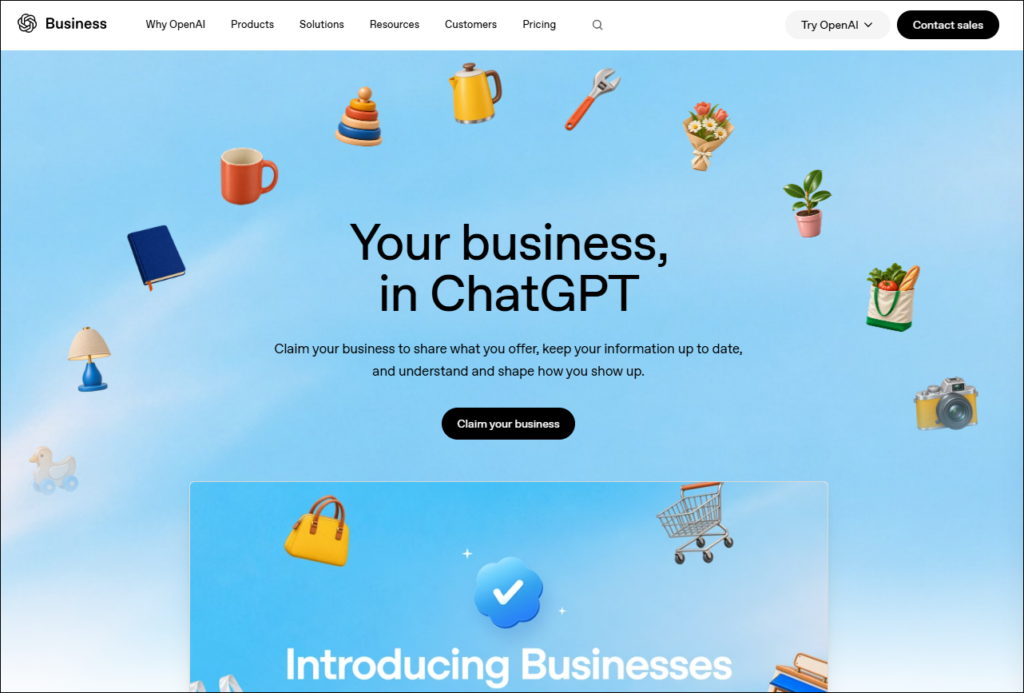
What Is ChatGPT Business Hub?
OpenAI says ChatGPT now reaches 1.2 billion people each week. Until this week, a business had no official way to tell ChatGPT anything about itself. The model built its picture from your website and from whatever the rest of the internet said about you.
Businesses in ChatGPT changes that. Through Business Hub, a company can claim its profile, verify ownership and update key details. Ecommerce businesses can add product feeds with pricing and availability, and Shopify merchants can connect their store directly.
A verified business also gets an insights dashboard. It reports mentions, website clicks and discovery topics, which are the common themes in conversations where the business is cited.
Who Can Claim A ChatGPT Business Profile In Australia?
OpenAI’s help centre says availability depends on a business’s location and type. Here is how that plays out for Australian businesses at launch.
Online stores and online service businesses are the group OpenAI has opened first. If your business isn’t listed yet, you may see an option to add it yourself.
Businesses that customers visit in person are further back in the queue. OpenAI states that local stores and restaurants can currently claim only an existing US listing.
Our own test shows what a service business sees. JBE Digital has a website and a listed street address. ChatGPT found the listing, let us start the claim and then placed us on a waitlist. So an Australian service business can get into the process today, and approval timing is still unknown.
Business Agents are a separate step with tighter rules. They are open to eligible ecommerce and online service businesses in the US, and the business must also meet OpenAI’s industry requirements.
If you search for your business and see “Contact support”, the listing is locked and access has to be requested from OpenAI.
How To Claim Your Business In ChatGPT
The claim starts at chatgpt.com/business-hub or from the ChatGPT sidebar.
- Log in with the ChatGPT account you want as the administrator
- Search for your business name and select it from the suggestions
- Click “Get started” on the claim prompt
- Verify that you are authorised to represent the business
- Wait for OpenAI to review the claim and email its decision
What You Need To Verify Your ChatGPT Business Profile
The claim itself is quick. Verification is where it slows down, so it helps to have these on hand:
- A work ChatGPT account for the person who will be the admin
- Access to the phone number or email address listed for your business, or to your domain’s DNS settings
- Business registration details that match your official records (in Australia, that will usually mean your ABN)
- Government-issued ID for the admin
- Proof that the admin is authorised to represent the business
There are two checks. The first confirms the business, using a code sent to the business phone or email, a TXT record added to your domain, or a Shopify connection. OpenAI then reviews the claim and emails its decision.
The second confirms the person. After the claim is approved, the admin completes identity verification through a provider called Persona. Publishing changes, viewing insights and connecting a product feed all stay locked until that check is approved, and the blue verified tick appears at the same point.
Two details are worth knowing before you submit. A brand new profile created through this process publishes automatically once approved. OpenAI’s support team also can’t delete or hide a published profile afterwards, so have your details right first.
Our Test: Claiming A ChatGPT Business Profile In Australia
We ran the claim for JBE Digital on 11 November, the first day it was available in Australia.
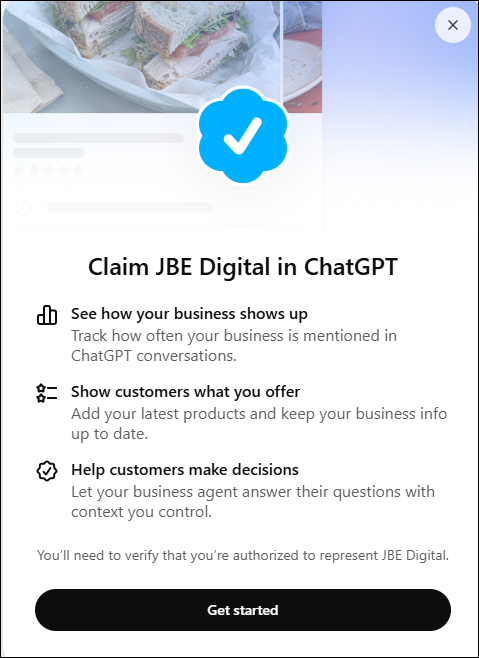
ChatGPT found our business straight away, with our Niddrie address already attached. The claim prompt listed three things a verified business can do: see how it shows up, show customers what it offers, and help customers make decisions through a business agent.
After we clicked “Get started”, the screen read “You’re on the waitlist”, with a note that OpenAI will email us when we can continue the claim.
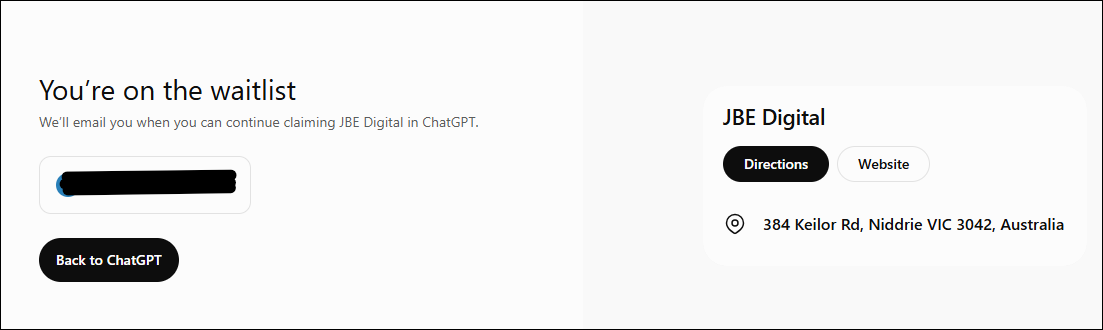
So the listing exists and the claim is open, and approval is queued. OpenAI hasn’t published how long the waitlist runs. We will update this article when our claim moves.
Our advice is to join the queue now. It takes a few minutes, and the businesses that claim early will have their information and their data in place first.
Claiming ChatGPT Listings For Franchises And Multi-Location Businesses
This is the thinnest part of the launch, and it matters for any business with more than one site.
OpenAI’s guidance is that each brand is managed separately. Claiming the main brand leaves its locations unclaimed, and there is no central management across a parent company’s brands and locations at this stage. For larger brands on a managed claim process, individual location profiles stay locked by default, and the next step runs through an OpenAI account contact.
Our advice to networks is to agree on the approach before any location claims a profile. Decide who holds the admin account, which details are used across every profile and how franchisees are told. A network where each location claims on a personal account, with its own wording, is hard to bring back into line later.
Head office claiming the main brand is the sensible starting point. It secures the profile that is open today and puts one team in control when location tools arrive.
Is Business Hub A Search Console For ChatGPT?
Trade press has called it a Search Console for ChatGPT, and the comparison is fair up to a point. For the first time, OpenAI is showing businesses first-party data on visibility inside ChatGPT.
The data is aggregated. Business Hub reports totals over the past 28 days and recurring themes, and individual prompts and conversations stay private. Metrics only appear once activity passes a minimum threshold, so a blank dashboard can mean the numbers are still building.
How a mention is counted depends on the type of business. For an online business, ChatGPT has to reference your website for it to count, and a brand name on its own goes unrecorded. For a local business, a mention is counted when ChatGPT shows a result for that location, even if nobody opens it.
The click count is the most useful figure for most businesses. It can be checked against ChatGPT referral traffic in GA4, which gives a second read on how much demand ChatGPT is sending your way. That kind of measurement sits at the centre of our AI SEO work.
ChatGPT Business Agents And ChatGPT Ads
A Business Agent is a branded chat that a customer can open from your profile. It answers questions about your products and policies using information you supply, in a conversation that is clearly labelled as separate from ChatGPT’s own answers.
At launch, Business Agents are available to eligible ecommerce and online service businesses in the United States. OpenAI says access will expand to more markets and categories over time and has given no date for Australia.
The feature also connects to paid media. OpenAI says a Business Agent can be the destination for a ChatGPT ad, and that ad format is in a limited test with selected advertisers. We cover the paid side in our guide to ChatGPT ads in Australia.
We test ChatGPT as a channel on our own account before recommending anything to clients. That covers ChatGPT advertising, where our first-week campaign data is published, AI SEO, and now Business Hub.
Does Claiming Your Business Improve ChatGPT Visibility?
A claimed profile fixes the facts. Your description, services, website and product details come from you, which reduces the chance of ChatGPT repeating something out of date.
Recommendations work differently. OpenAI states that claiming carries no guarantee of higher placement or sales, and that ChatGPT may still draw on other sources when it answers questions about your business. The model keeps weighing reviews, case studies, third-party mentions and the depth of your own content.
That is the same credibility work that drives search engine optimisation and AI citations today. We set out how it compounds in Why Trust Is the Real Growth Constraint in the AI Era.
What To Do While You Wait For ChatGPT Business Hub Access
A waitlist or an ineligible listing still leaves useful work to do, and all of it carries over once the claim opens.
Start with a baseline. Ask ChatGPT the questions your buyers ask and save what it says about your business, your services and your competitors. When your profile goes live, you will have something to compare against.
Check your analytics as well. Clicks from ChatGPT already arrive tagged with utm_source=chatgpt.com, so GA4 can show how much traffic it sends you today.
Then look at the information ChatGPT is already reading. A claimed profile is one input, and OpenAI says ChatGPT may also use other sources. Your website, your reviews and what other sites say about you should all describe the business the same way. We cover how that credibility gets built in The Formation Stage and how results become usable proof in The Proof Activation Stage.
It also helps to settle the admin question now. Choose the person and the work account that will own the profile, so the claim can move the day OpenAI’s email arrives.
Frequently Asked Questions
Can Australian businesses claim their business in ChatGPT?
Online stores and online service businesses in Australia can start the claim in Business Hub now. When we tested it on 11 November 2026, ChatGPT found our listing and placed the claim on a waitlist. OpenAI states that local stores and restaurants can currently claim only an existing US listing.
How much does it cost to claim a business in ChatGPT?
OpenAI has told trade press that claiming a profile and publishing a Business Agent are free at launch. It has left open the option of charging in future. OpenAI’s help centre confirms that no Ads account or ChatGPT Enterprise agreement is needed to claim.
Does claiming your business improve your ranking in ChatGPT?
OpenAI states that claiming carries no guarantee of higher placement or sales. ChatGPT continues to make independent recommendations and may use other sources. Claiming improves the accuracy of what ChatGPT says about you, and wider credibility signals shape whether you get recommended. This is the focus of AI SEO.
What data does ChatGPT Business Hub show?
Business Hub shows aggregated mentions, website clicks and discovery topics over the past 28 days. Businesses don’t see individual prompts or conversations. Metrics appear once activity passes a minimum threshold.
What is a ChatGPT Business Agent?
A Business Agent is a branded chat inside ChatGPT that answers customer questions using information the business supplies. It is available at launch to eligible ecommerce and online service businesses in the United States. It can also serve as the destination for a ChatGPT ad.
How is Business Hub different from ChatGPT ads?
Business Hub manages how your business appears in ChatGPT’s organic answers and reports on that visibility. ChatGPT ads are paid placements shown alongside answers. OpenAI says advertising has no influence on ChatGPT’s independent answers.
Who should claim the profile, the business or its agency?
The business. OpenAI requires the claim to come from the owner or someone authorised to represent the business, and that person completes the identity check. Once approved, the admin can give teammates or an agency access in Business Hub, with each person using their own ChatGPT account.
Can a franchise claim all of its locations at once?
No. OpenAI says each brand is managed separately and claiming the main brand leaves its locations unclaimed. Central management across a parent company’s brands and locations isn’t available yet.
The Strategic Implication
Most businesses will treat this as a listing to tick off, the same way they treated Google Business Profile a decade ago.
The bigger shift is that ChatGPT is building the full set of business tools Google has: a profile, a data console, an ad platform and now a link between them. Businesses will soon manage their presence in ChatGPT with the same discipline they apply to Google.
A claimed profile tells ChatGPT who you are. The proof around your business, in reviews, case studies and mentions across the web, tells ChatGPT whether to recommend you.
Claim the profile this week, then keep building the proof that makes the profile worth showing.